01
The “Watch Spot”
A soft spot your dentist has been monitoring for a year or two. Instead of watching it get worse, we can treat it now — while it’s still reversible.
Early Enamel Lesion

Caught early enough, a cavity doesn’t have to become a filling. Curodont® uses a self-assembling peptide to rebuild weakened enamel from the inside out. The appointment adds about ten minutes to a visit you’re already in — the enamel then rebuilds over the months that follow.
Treats early, non-cavitated decay only · Same-visit treatment · Priced per tooth, quoted before we start
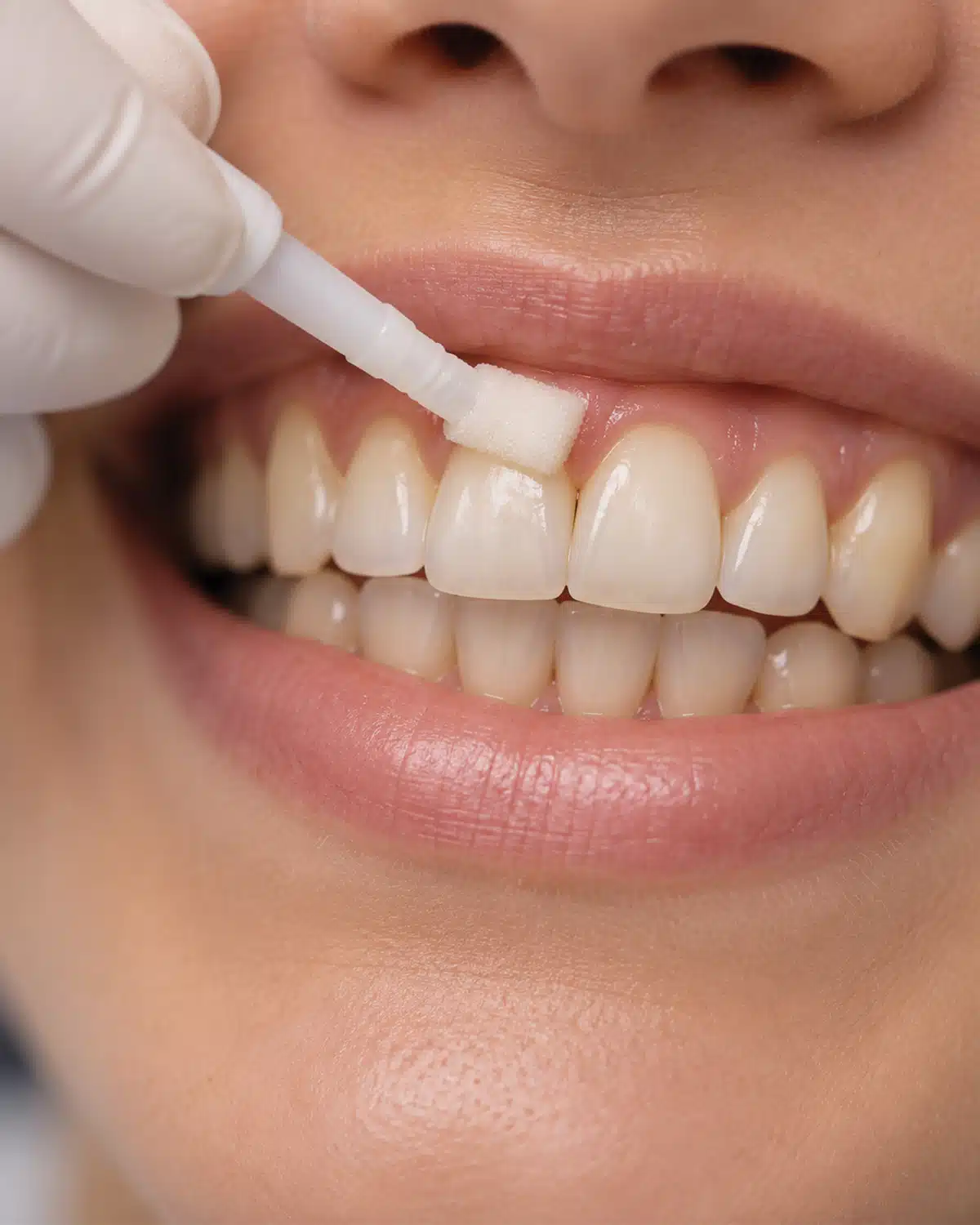
Curodont is a non-invasive, in-office treatment for early tooth decay. A liquid containing a self-assembling peptide called P11-4 is applied to the softened spot in your enamel, where it forms a microscopic scaffold that pulls calcium and phosphate out of your saliva and guides new mineral to form throughout the lesion. Combined with fluoride, it is used to arrest early decay — and fade the white spots that come with it — before the tooth ever needs to be drilled and filled. At Ethos Advanced Dental Care in Temecula it is placed in the same visit the lesion is found, with no anesthetic, no drilling, and no filling material. The appointment itself takes about ten minutes; the enamel rebuilds gradually over the following weeks and months, and we recheck the tooth at your next cleaning.
For decades, a dentist who spotted early decay had two choices: drill a tooth that wasn’t broken yet, or “watch it” and wait for it to get worse. Fluoride helped at the surface. Neither option did much for the mineral already lost deeper in the lesion.
Curodont gives us a third option. The peptide diffuses into the porous, softened part of the enamel and assembles into a scaffold that mimics the natural enamel matrix — then calcium and phosphate from your own saliva crystallize along it, throughout the depth of the lesion rather than just its surface. The tooth stays whole. Nothing is removed.

Curodont is for decay that has started but hasn’t broken through. If you’ve been told you have a “watch spot,” a shadow between two teeth, or white marks after braces, this is the conversation to have.
A soft spot your dentist has been monitoring for a year or two. Instead of watching it get worse, we can treat it now — while it’s still reversible.
Early interproximal decay caught on a bitewing X-ray — E1, E2 or non-cavitated D1. Treated from both sides, with no separators and no wedging.
Chalky marks left where plaque sat around brackets. If they’re early decay, Curodont is built for them — and many fade as the enamel remineralizes.
For a child’s first “cavity,” or an adult who’s been avoiding the chair for years, a treatment with no needle and no drill changes the whole visit.
It cannot fix a cavity that has already broken through. Once the enamel surface collapses into an actual hole, there’s nothing left to rebuild along, and the tooth needs a filling or a crown. Curodont also isn’t indicated for white marks that aren’t decay — fluorosis, developmental enamel defects, or trauma — where current evidence doesn’t support it, and cosmetic options are the better conversation.
And it isn’t a coating for healthy teeth. It’s a treatment for a specific lesion, not a substitute for brushing, flossing, cutting back on how often you snack, or keeping your cleanings.
The appointment happens in the visit you’re already sitting in — usually right after your cleaning. The rebuilding it starts plays out over the months after you leave.
Curodont only works on decay caught before it cavitates, so this starts with a careful exam and bitewing X-rays. If we see an early lesion, we show it to you on screen.
We clean the tooth and briefly condition the enamel so the liquid can diffuse into the lesion instead of sitting on top of it. For spots between teeth, we floss the contact clear — no separators needed.
A small sponge carrying the P11-4 peptide and fluoride is placed against the lesion. It’s tasteless, it doesn’t stain, and there’s no injection and no drilling — most patients say it feels like having fluoride placed.
Inside the lesion, the peptide monomers self-assemble into a three-dimensional matrix that mimics natural enamel — the framework new mineral will grow along.
This is the part that takes time. Calcium and phosphate from your own saliva crystallize along the scaffold over the following weeks and months — how fast depends on your saliva, your hygiene, and your diet. We ask you not to eat, drink, or rinse for 30 minutes, then you carry on with your day.
At your next recall we re-evaluate the tooth. Most lesions need only one application; if it still looks active at around six months, we can place a second.
We’d rather show you the numbers than make you a promise. Here’s where the published evidence on self-assembling peptide P11-4 stands today.
A systematic review and meta-analysis pooling six clinical trials found early lesions treated with P11-4 were about 1.8 times as likely to arrest as controls (RR 1.82, 95% CI 1.32–2.50), with an average 32% decrease in lesion size and a number-needed-to-treat of 2.8.
In a randomized controlled trial of 58 early lesions, 65.5% of those treated with Curodont Repair Fluoride Plus showed complete reduction at six months, compared with 13.8% treated with fluoride varnish — and roughly 60% lower risk of progression.
The manufacturer reports more than three million teeth treated in the United States with no reported side effects. The formula is an over-the-counter anticavity rinse — 0.05% sodium fluoride — labeled for professional office use only.
| Curodont® | Fluoride Varnish | Drill & Fill | |
|---|---|---|---|
| Best for | Early, non-cavitated decay | Prevention & surface strengthening | Decay that’s broken through |
| Healthy tooth removed | None | None | Yes — permanently |
| Numbing injection | No | No | Usually |
| Where it works | Throughout the lesion depth | Mainly at the surface | Replaces the tooth structure |
| Chair time | About 10 minutes | A few minutes | 30–60 minutes |
| Lifetime commitment | None — tooth stays intact | None | Filling will need replacing |
Curodont and fluoride aren’t rivals — fluoride varnish can be placed at the same visit, at least five minutes after the Curodont application. The real comparison is Curodont versus waiting.
Curodont is priced per tooth, so your cost depends on how many lesions we’re treating. Plan on paying out of pocket — coverage for it is still rare. You’ll get the exact number in writing at your visit, before anything is placed.
The early-decay check costs nothing. We review your X-rays and exam findings and tell you whether Curodont is an option — or whether the lesion is past it.
CDT D2991 was added to the 2024 code set for this treatment, but few plans pay on it yet. We check yours and tell you either way.
Since most patients pay out of pocket, the Ethos Care Plan takes 20–30% off most treatments — and CareCredit® and Sunbit are there if you’d rather spread it out.
Free early-decay check · X-ray review · Same-visit treatment if you’re a candidate · Exact cost quoted before anything is placed
Claim Your Free CheckNew patient exam & X-rays $99 (excludes patients with insurance). Curodont treatment is quoted separately, per tooth, and is not covered by most dental plans.
Not every practice in the Temecula Valley offers a treatment that talks patients out of fillings. We think that’s exactly the point.
If a lesion is early enough to reverse, we’d rather reverse it than schedule you for a filling in two years.
Patients consistently praise our gentle, personalized dentistry and honest communication at every visit.
Curodont only helps if the lesion is found early — which is why our diagnostics and recall exams are built around catching it.
Early morning, evening, and Saturday appointments — treatment placed in the visit you’re already here for.
Ethos Advanced Dental Care has earned more than 1,500 five-star Google reviews from patients across the Temecula Valley.

“Two dentists had been ‘watching’ the same spot for years. Ethos treated it in ten minutes — no shot, no drill. I didn’t know that was even possible.”
“My daughter got white spots after her braces came off and we were dreading fillings. They explained the options honestly and she wasn’t scared for a second.”
Everything patients ask before treating early decay without a drill. Have a question not covered here? Call us — our team is happy to talk it through.
(951) 699-0700Curodont is a non-invasive, in-office treatment for early tooth decay. A liquid containing a self-assembling peptide called P11-4 is applied to the softened spot in your enamel, where it forms a microscopic scaffold that pulls calcium and phosphate out of your saliva and guides new mineral to form throughout the lesion. Paired with fluoride, it’s used to arrest early decay before it becomes a cavity that needs drilling and filling.
For early, non-cavitated lesions the published evidence is encouraging. A 2023 systematic review and meta-analysis in the Journal of the American Dental Association pooled six clinical trials and found lesions treated with P11-4 were about 1.8 times more likely to arrest than controls, with an average 32% decrease in lesion size. A 2024 randomized trial in Clinical Oral Investigations found 65.5% of lesions treated with Curodont Repair Fluoride Plus showed complete reduction at six months, versus 13.8% with fluoride varnish alone.
Those trials are small and short-term, and individual results vary. Curodont is a strong reason to treat an early lesion rather than watch it — not a guarantee that a tooth will never need a filling.
No. There’s no anesthetic injection, no drilling, and no filling material. The tooth is cleaned, briefly conditioned, and the liquid is applied with a small sponge. Most patients describe it as no different from having fluoride placed. It’s tasteless and doesn’t stain the tooth.
Plan on roughly ten minutes of added chair time, and it’s almost always done at the same visit where we find the lesion. Afterward we ask you not to eat, drink, or rinse for 30 minutes. There’s no numbness to wait out and no follow-up appointment to restore the tooth.
Longer than the appointment. The treatment takes about ten minutes, but the remineralization it starts is a gradual biological process — not a filling that’s finished when you stand up.
In the published trials, measurable differences from fluoride varnish showed up at the three- and six-month checks. How quickly it goes for you depends on your saliva, your oral hygiene, and your diet. We don’t ask you to judge it by how the tooth looks the next morning — we re-evaluate it at your next cleaning.
Curodont is for early, non-cavitated decay: white spot lesions on smooth surfaces, early shadows between teeth that read as E1, E2 or non-cavitated D1 on an X-ray, ICDAS 1–2 lesions, and early decay around orthodontic brackets.
It cannot treat a cavity that has already broken through into a hole — that still needs a filling or a crown. It’s also not indicated for white marks caused by something other than decay, such as fluorosis, enamel hypomineralization, or trauma, and it isn’t meant to be applied to healthy, intact enamel as a general preventive.
It’s used across all ages, and for children under six the manufacturer advises discussing treatment with the dentist or physician first. The formula is an over-the-counter anticavity rinse containing 0.05% sodium fluoride, labeled for professional office use only, and the manufacturer reports more than three million teeth treated in the United States with no reported side effects.
For a nervous child with an early lesion, it’s often the difference between a positive visit and a first experience with a needle and a drill.
If the white spots are early decay left behind by plaque around brackets, Curodont is designed for exactly that situation, and many patients see the spots fade as the enamel remineralizes. That fading is gradual — think months, not days — and how much they fade depends on how deep and how old the lesion is.
If the white marks are from fluorosis or a developmental enamel defect rather than decay, current evidence doesn’t support treating them this way — we’d talk with you about cosmetic options instead. Worth knowing if you’re considering Invisalign: clear aligners are removable, which makes white spots far less likely than with brackets in the first place.
In most cases a single application treats a single lesion. We re-evaluate the tooth at your next recall visit, and if the lesion still looks active we can place a second application at about six months. Curodont works alongside your daily brushing and flossing, your diet, and your regular cleanings — it doesn’t replace any of them.
Usually not — plan on paying out of pocket for this one. There is a dedicated code for it, CDT D2991, “application of hydroxyapatite regeneration medicament, per tooth,” introduced in the 2024 code set. But a code existing isn’t the same as a plan paying on it, and so far only a small number of plans do.
We verify your specific benefits before treatment and tell you either way, along with the exact out-of-pocket cost. If it isn’t covered, ask about the Ethos Care Plan.
Cost depends on how many teeth are being treated, since it’s priced per tooth. We quote it in writing at your visit, and you should expect it to be out of pocket — very few dental plans currently cover it. For context, it’s typically a fraction of what a filling costs, and a filling is a permanent commitment to restoring that tooth for the rest of your life. Your early-decay check itself is complimentary.
Yes. Curodont treats a specific lesion that’s already there; it doesn’t protect the rest of your mouth. Regular cleanings, daily brushing and flossing, and reducing how often you snack on sugar and acid are what keep new lesions from starting. Fluoride varnish can also be placed at the same visit, at least five minutes after the Curodont application.
Patients drive to our Rancho California Road office from across southwest Riverside County and north San Diego County.
Curodont pairs naturally with the rest of your care here — family dentistry and cleanings, where early lesions get caught in the first place, and Invisalign for teens, where avoiding white spots is part of the point. See all dental services at Ethos.
Your early-decay check is complimentary. We’ll review your X-rays, show you what we see, and tell you honestly whether Curodont can still help — or whether that window has closed. Call the office, or book online and we’ll reach out to schedule.
Tap to call on mobile · New patients welcome
Important Details
Curodont® Repair Fluoride Plus is an over-the-counter anticavity rinse (sodium fluoride 0.05%, 0.02% w/v fluoride ion) marketed under the FDA OTC monograph for anticaries drug products and labeled for professional dental office use only; the self-assembling peptide component is Oligopeptide-104 (P11-4). It is indicated for early, non-cavitated carious lesions and is not a treatment for cavitated decay, which requires restorative care. Current evidence does not support its use for white marks of non-bacterial origin, such as fluorosis or developmental enamel defects. Clinical figures cited on this page are drawn from a 2023 systematic review and meta-analysis in the Journal of the American Dental Association, a 2024 randomized controlled trial in Clinical Oral Investigations (Shaalan O et al., 2024;28:438), and manufacturer data on file; published trials to date are small and short-term, and individual results vary. Remineralization is a gradual biological process measured over weeks and months after treatment, not an immediate change at the appointment. Nothing here is a guarantee of outcome or a substitute for examination and diagnosis by a licensed dentist. Curodont® is a registered trademark of credentis AG / vVARDIS. The Ethos Care Plan is an in-house membership savings plan and is not dental insurance. Curodont is generally not a covered benefit under most dental plans; the presence of CDT code D2991 does not guarantee coverage, and patients should expect out-of-pocket cost. Ethos Advanced Dental Care is an independently owned and operated dental practice serving Temecula, CA. (951) 699-0700